Do you know about TypeScript contravariance on function parameters. It means function types are contravariant. It means for function types, parameter types go the “opposite way” compared to the usual “subtype” story.
Let us say you have two classed Animal and Dog.
class Animal { readonly legs = 4;}class Dog extends Animal { bark() { console.log('Woof!'); }}
And two types created as shown below,
type AcceptDog = (d: Dog) => void;type AcceptAnimal = (a: Animal) => void;
Now you have two functions,
const handleAnimal: AcceptAnimal = (a) => { console.log(a.legs);};const handleDog: AcceptDog = (d) => { d.bark();};
Now let us use these functions and types. Below is very much allowed and you can pass the type derived from Animal to Dog.
const f :AcceptAnimal = handleAnimal; // correct
const g :AcceptDog = handleDog; // correct
const i :AcceptDog = handleAnimal; // correct
But if you pass Dog to Animal, TypeScript complains about that.
const j :AcceptAnimal = handleDog; // error
For above assignment, TypeScript gives compile time error,
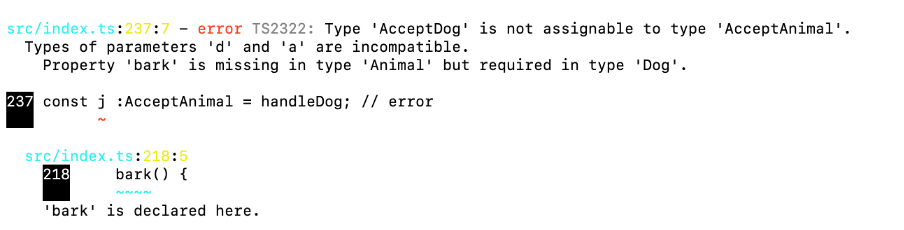
Dog is a subtype of Animal that means , every dog is an animal So normally, If something works with Animal, it automatically works with Dog. But in context of function types, it reverses and parameter types go the “opposite way” compared to the usual “subtype” story.
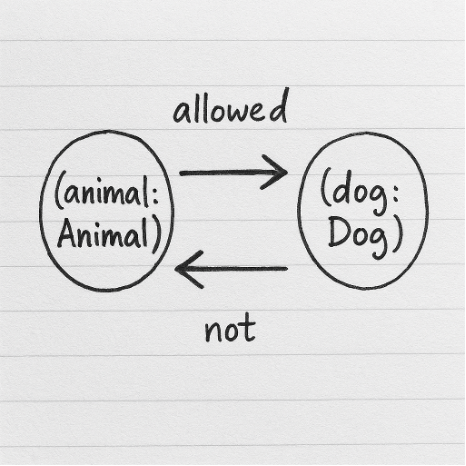
- If
Dogis a subtype ofAnimal(a dog is an animal), - then a function that accepts
Animalis more useful than one that only acceptsDog. - So
(animal: Animal) => voidcan be used where(dog: Dog) => voidis expected — but not the other way around.
That “parameters flip the direction” is contravariance in TypeScript function parameters.
I hope now you know about contravariance in TypeScript. Thanks for reading.
Also, we are hosting the 8th edition of India’s Largest Angular Conference in Gurgaon on 11 April. You can find more details here – https://www.ng-ind.com/home
Discover more from Dhananjay Kumar
Subscribe to get the latest posts sent to your email.
 Dhananjay Kumar